01
Clinical Documentation Audit
We review patient charts and encounter notes for completeness and compliance prior to code assignment.
Medical Coding Services
Dastify Solutions provides medical coding services built around certified expertise, specialty-aligned coding teams, and AI-assisted validation workflows. When you outsource medical coding to our AAPC and AHIMA-certified coders, supported by NCCI pre-submission checks, you reduce front-end coding errors that commonly lead to preventable claim denials. We handle ICD-10 coding services, CPT coding services, and HCPCS coding services across 75+ specialties, with audit-ready documentation protocols and payer-specific reimbursement workflows integrated into every claim.

Our Workflow
We review patient charts and encounter notes for completeness and compliance prior to code assignment.
Our certified coders apply accurate, payer-aligned codes using AI-assisted validation for consistency across specialties and payer requirements.
We run claims through payer policies, NCCI edits, and compliance checks before submission to ensure errors are identified and resolved before reaching the payer.
Our team addresses coding discrepancies efficiently and resubmits claims through clearinghouses with corrected documentation attached.
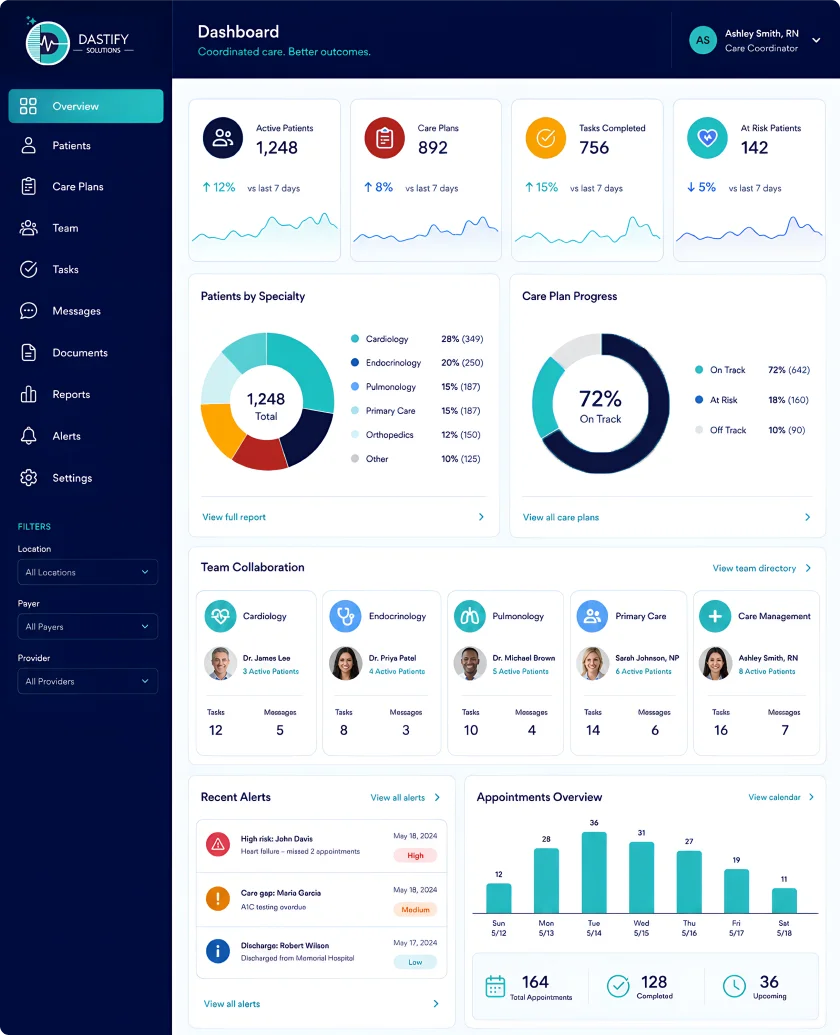
We deliver customized dashboards to track denial rates, collection ratios, financial performance and coding productivity metrics.
Accuracy & Compliance
Incorrect modifier application is a leading cause of claim denials and audit risk. Modifier 25 requires distinct documentation of the evaluation beyond the procedure itself. Modifier 59 requires anatomical or temporal distinction documented in the clinical record. We validate modifier application against NCCI edit pairs and payer-specific modifier policies before every claim submission, reducing modifier-related denials and minimizing audit exposure.
Accurate coding requires accurate documentation. When a physician's note uses a non-specific diagnosis, a generic finding instead of a confirmed diagnosis, or omits the severity indicators that support higher-acuity coding, the coder either undercodes or introduces compliance risk. We identify documentation gaps before coding, not after denial, and generate physician queries that clarify the clinical picture compliantly without suggesting codes.
Before changing coding workflows, practices need to understand where current coding is failing. Our retrospective coding audit reviews a statistically valid sample of your historical claims, typically 30 to 50 records per specialty, and identifies undercoding patterns, overcoding patterns, modifier errors and diagnosis specificity gaps. The audit report quantifies the financial impact of each issue.
Specialty Expertise
Not every coding error looks the same. Each specialty has rules that generalist coders often misapply in high-volume environments. Our teams are assigned by specialty, not mixed-queue, so your orthopedic claims are not coded by someone who spent the morning on behavioral health.
These examples represent just a fraction of the 75+ specialties we code for nationwide. Each specialty has distinct documentation standards, modifier rules, bundling edits, and reimbursement logic. Our workflows are configured to align with each specialty's coding and payer requirements.
Here are examples of the specialty-level coding complexity we handle:
Regulatory Compliance
Our medical coding services are built around strict compliance with U.S. healthcare regulatory standards. We protect patient information, follow national standards and keep our staff trained on the latest requirements.
Every claim containing patient PHI follows HIPAA's Privacy and Security Rules for data handling and transmission.
Accurate procedure and diagnosis coding directly supports your MACRA reporting requirements by ensuring the services being measured are correctly captured.
Accurate diagnosis coding directly affects your MIPS quality measure performance. Conditions coded at insufficient specificity generate incorrect denominator inclusions that skew quality scores.
For ACO participants, diagnosis coding accuracy determines attributed beneficiary risk scores that affect shared savings calculations.
Correct coding ensures your practice's quality data reflects actual clinical performance rather than documentation gaps that understate complexity.
Our team receives continuous training on updates in HIPAA and GDPR, CMS Fraud Waste and Abuse (FWA) policies, and social engineering and data security best practices.
KPIs We Improve
We monitor coding productivity and error patterns in real time through OFC, identifying systematic coding gaps before they translate into denial trends.
We ensure HCC-mapped ICD-10 coding reflects documented chronic condition severity, protecting Medicare Advantage risk-adjusted reimbursement.
We reduce DNFB by identifying and resolving documentation holds quickly so claims move to billing within target turnaround times.
We track DNFC days by coder and case type, using OFC-driven turnaround targets to prevent coding backlogs from building into AR delays.
We apply ICD-10-CM/PCS and MS-DRG rules to ensure the assigned DRG reflects the full complexity of the inpatient encounter, preventing underpayment on high-acuity cases.
Correct DRG assignment and complete comorbidity capture improve CMI accuracy, directly influencing reimbursement rates from Medicare and commercial payers.
We deliver medical billing and coding services for 75+ specialties across all 50 states - dedicated, specialty-trained coding teams aligned to each clinical area.
FAQ
No matter your practice size or location, accuracy is guaranteed. Partner with a medical coding company that builds workflows around your specialty's rules, not a one-size-fits-all approach that overlooks critical coding and reimbursement details.
Talk to an Expert